The Psychology of Spending: Why We Buy Things We Don't Need
A deep dive into the behavioral science behind impulse buying, emotional spending, and the cognitive biases that make us spend more than we should — plus practical strategies to counteract them.
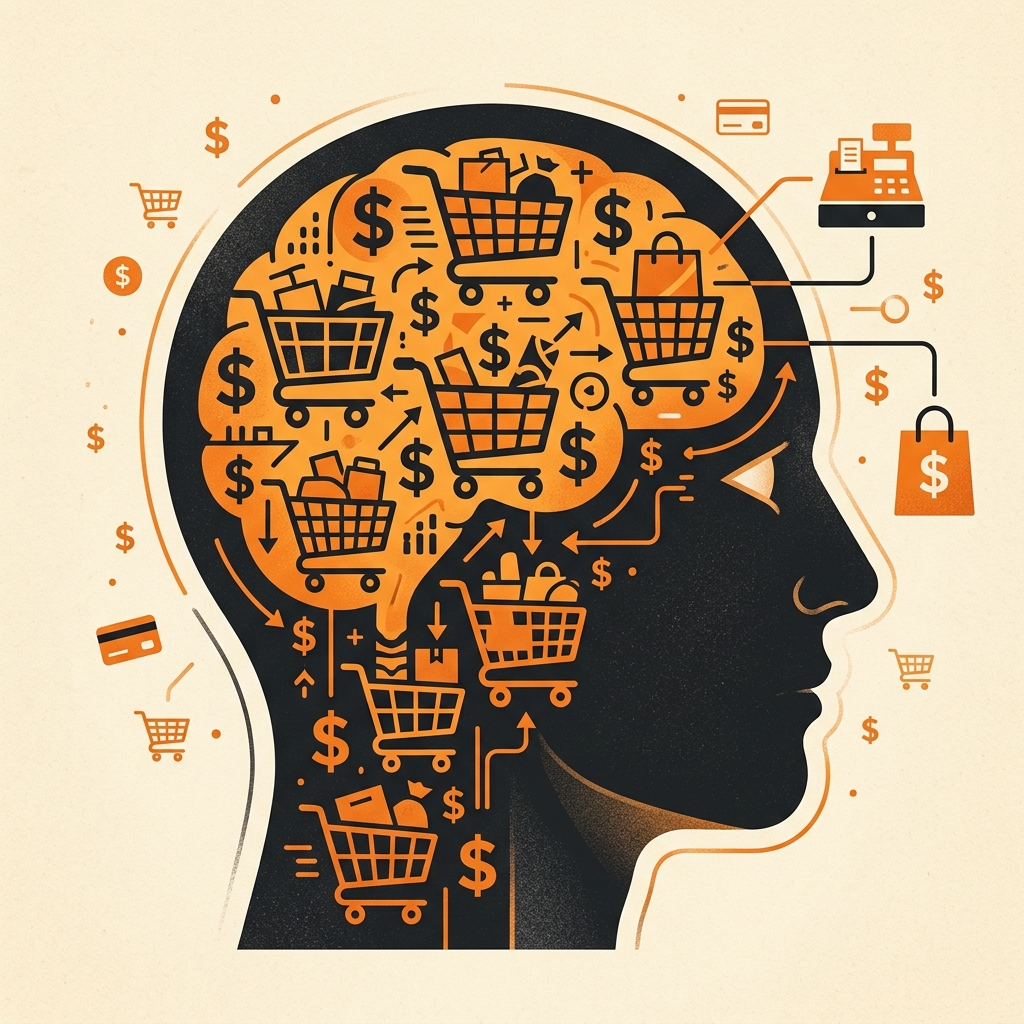
You don’t have a willpower problem. You have a brain that evolved for a world without Amazon, Instagram ads, and one-click purchasing. Understanding the specific psychological mechanisms that drive unnecessary spending is the first step toward spending more intentionally — not through white-knuckle discipline, but through system design that works with your brain instead of against it.
The Seven Cognitive Biases That Empty Your Wallet
1. The Anchoring Effect
When you see a ₹5,999 product crossed out with a “sale price” of ₹2,999, your brain doesn’t evaluate whether ₹2,999 is a fair price for what you’re getting. Instead, it evaluates ₹2,999 relative to ₹5,999 and concludes it’s a bargain. The original price is the “anchor,” and it distorts your perception of value regardless of whether the product was ever actually sold at ₹5,999.
Retailers exploit this ruthlessly. Research shows that displaying a higher reference price increases purchase probability by 30-40%, even when consumers are told the reference price is arbitrary. Your rational brain knows the “original price” is probably inflated; your emotional brain still feels the thrill of a “deal.”
Counter-strategy: Before buying anything on sale, ask one question: “Would I buy this product at this price if there were no strikethrough price, no sale badge, no countdown timer?” If the answer is no, the “deal” is the product — and the product isn’t worth it.
2. The Endowment Effect
Once you own something — or even imagine owning it — you value it more than before you had it. This is why “30-day free trials” are devastatingly effective. After using a premium service for a month, you perceive canceling as “losing” something, not as “saving money.”
The endowment effect also explains why people overpay for upgrades. You already own the basic version; the premium version adds 10% more features but costs 50% more. Logically, the math doesn’t work. Emotionally, losing those features (which you’ve now experienced) feels painful.
Counter-strategy: When evaluating any subscription or upgrade, frame it as a new purchase, not a renewal. Ask: “If I didn’t already have this, would I start paying for it today at this price?“
3. Social Proof and Comparison
“Best-selling,” “most popular,” “trending now” — these labels leverage our deep evolutionary need to do what others are doing. In prehistoric times, following the group improved survival odds. In 2026, it improves retailers’ conversion rates.
Social media amplifies this exponentially. You see a friend’s new watch, a colleague’s vacation photos, an influencer’s skincare routine. Each exposure creates a micro-desire that accumulates into spending decisions driven not by your own preferences but by social comparison.
Counter-strategy: Create intentional distance between exposure and purchase. When you see something someone else has and want it, add it to a “30-day list.” If you still want it in 30 days, it might be a genuine preference. Most items fall off the list within a week.
4. The Pain of Paying (or Lack Thereof)
Physical cash hurts to spend. Literally — brain scans show that paying with cash activates the insula, a region associated with physical pain and disgust. This “pain of paying” acts as a natural brake on spending.
Digital payments eliminate this pain almost entirely. Tapping a card, scanning a QR code, or clicking “Buy Now” with a saved card removes the visceral feedback that something is leaving your possession. This is why research consistently shows that people spend 12-18% more when using digital payments compared to cash.
Counter-strategy: You can’t (and shouldn’t) go back to cash. Instead, create artificial friction: remove saved cards from shopping apps, disable one-click purchasing, require two-factor authentication for online purchases above a threshold amount. Each friction point gives your rational brain a moment to engage before the emotional brain completes the transaction.
5. Present Bias (Hyperbolic Discounting)
Your brain heavily discounts future rewards in favor of immediate gratification. A ₹1,000 purchase today feels more valuable than ₹1,200 saved in a year, even though the math strongly favors waiting.
This bias is why saving is hard and spending is easy. Saving requires sacrificing a definite present pleasure for an uncertain future benefit. Every evolution of your brain screams: take the sure thing now.
Counter-strategy: Make future rewards concrete and vivid. Instead of “save ₹5,000/month,” frame it as “in 12 months, I’ll have ₹60,000 for a trip to Ladakh.” Attach specific goals to savings targets. When the future benefit is vivid and emotionally resonant, present bias weakens.
6. The Sunk Cost Fallacy
“I’ve already paid for the gym membership, so I have to go.” Logically, the money is gone whether you go or not. The decision should be based solely on whether going to the gym is the best use of your next hour, not on money already spent.
The sunk cost fallacy keeps you paying for subscriptions you don’t use (“I might use it next month”), finishing meals you don’t want (“I paid for it”), and continuing projects that aren’t working (“I’ve invested too much to stop”).
Counter-strategy: Ask: “If I hadn’t already spent money on this, would I choose to spend money on it today?” If no, the investment is already lost — cut your losses.
7. Retail Therapy (Emotional Spending)
Stressed, bored, sad, tired, or anxious? Shopping provides a temporary dopamine hit that relieves negative emotions. The problem isn’t the dopamine—it’s that the relief is fleeting (typically 20-30 minutes), while the financial impact is permanent.
Research from the Journal of Consumer Psychology found that people spend 30% more when emotionally distressed compared to baseline states. Retailers know this, which is why sale emails arrive on stressful days (Monday mornings, holiday periods) and shopping apps send notifications during typical low-energy hours (3-5 PM).
Counter-strategy: Build an “emotional spending firewall.” When you feel the urge to buy something outside your budget, delay the purchase by 24 hours and do one of these instead: take a walk, call a friend, exercise, or write in a journal. If after 24 hours you still want the item, buy it — but 70% of the time, the emotional urge will have passed.
Building a System That Works With Your Brain
Individual willpower is unreliable. Systems are consistent. Here are five system-level changes that address the biases above:
-
The 30-Day Wish List: Every non-essential purchase above ₹500 goes on a list. Review it after 30 days. You’ll buy about 30% of what goes on the list — a 70% reduction in impulse spending.
-
The Spending Pause: Set up your bank app to send a notification 5 seconds before completing any purchase above ₹1,000. Use that moment to consciously evaluate.
-
Environmental Design: Unsubscribe from marketing emails. Unfollow influencer accounts that trigger spending. Remove shopping apps from your home screen. Reducing exposure is more effective than resisting temptation.
-
The Joy-Per-Rupee Filter: For every discretionary purchase, ask: “Will this bring me joy next week? Next month?” If the answer is only “right now,” it’s an emotional purchase, not a lifestyle choice.
-
Automated Savings: Remove the daily savings decision entirely. Auto-transfer savings on salary day. What you don’t see in your spending account, you don’t spend.
The goal isn’t to stop spending — it’s to spend on purpose. Understanding your brain’s biases is the first step. Designing systems that account for them is the lasting solution.
PayWise Team
Personal finance enthusiast and tech writer at PayWise. Passionate about making digital finance accessible to everyone through practical, experience-based guides.